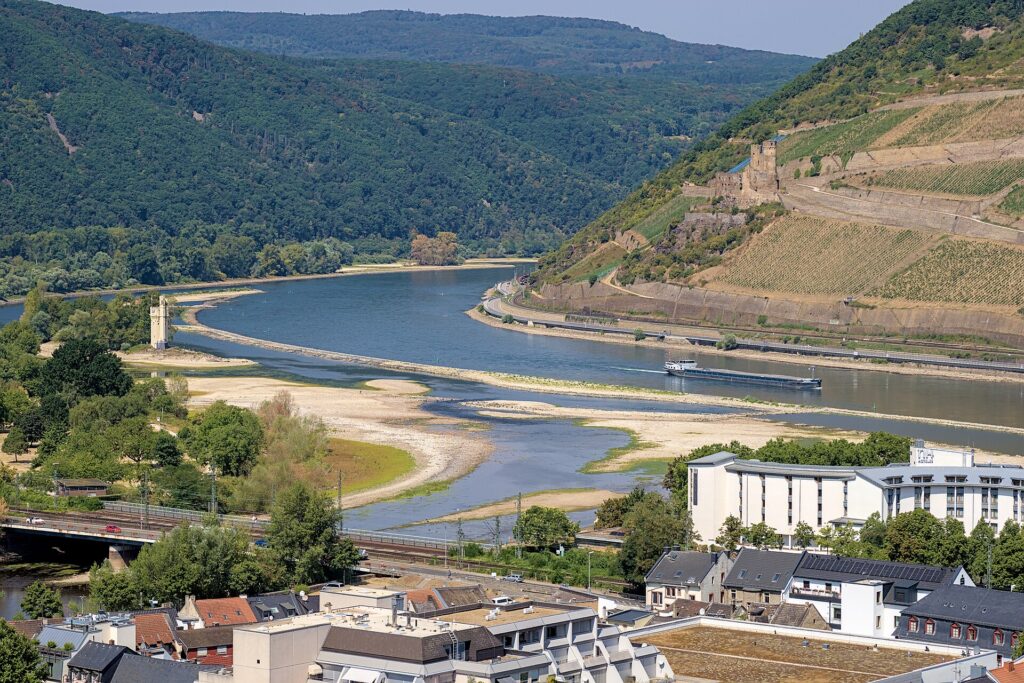

Rhine water levels have fallen further this summer than at any point on record. On the evening of 18 August 2026, the measuring station at Kaub in western Germany read 14 centimetres, against a previous record low of 25 centimetres set in October 2018.
If you have booked a river cruise on the Rhine or the Danube in the coming weeks, you should expect your ship to be unable to follow the route printed in your brochure. Riviera Travel has cancelled ten cruises and changed the route of six more.
Low water of the kind that disrupts river cruises usually arrives in the autumn. This year the record was broken in the first week of August, and the stretch of the Rhine between Rüdesheim and Koblenz has become too shallow for most cruise ships to pass. The cruise lines have not abandoned the season, however. They are carrying passengers around the shallow section by coach and moving them from one ship to another.
The Key Facts
- 14 centimetres at Kaub on 18 August against a previous record low of 25 centimetres in 2018
- Ten Riviera Travel cruises cancelled and six more rerouted so far this summer
- 13 centimetres at Budapest where the previous record low on the Danube was 33 centimetres
- 18 of 34 Viking docking points on the Amsterdam to Basel route could not be used on 14 August
- A full refund is due if the change is significant, although compensation is usually not payable
What Is Happening on the Rhine
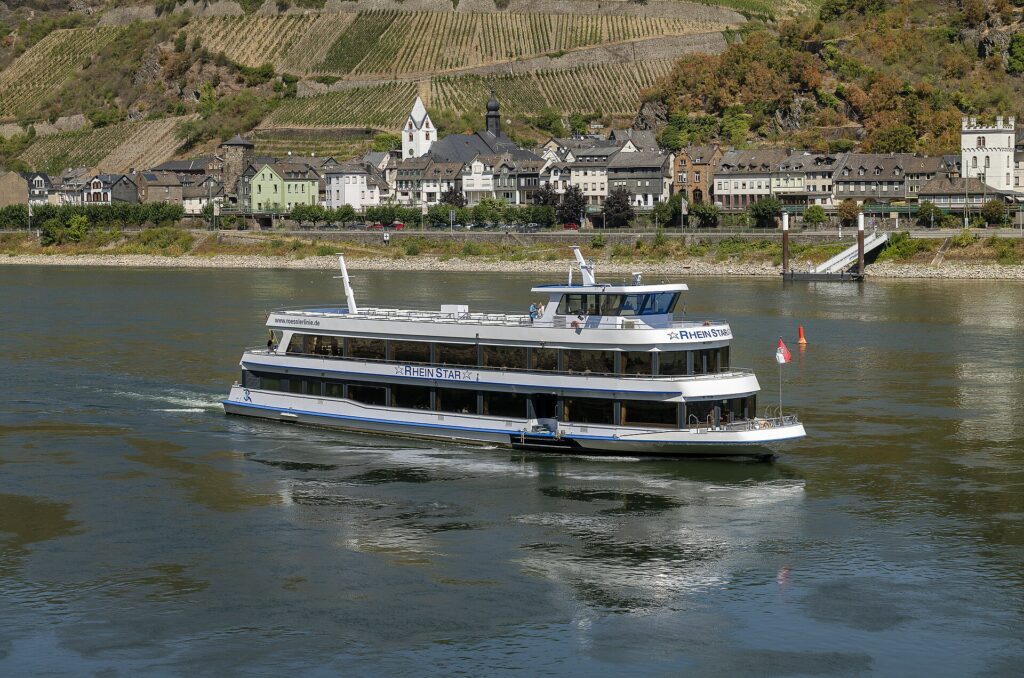
Kaub is a village on the Middle Rhine, roughly midway between Koblenz and Mainz. Its measuring station matters because the river is shallower there than at any other point on the German Rhine, so it runs out of water before anywhere else does. The reading fell to 6 centimetres on 14 August and stood at 6 centimetres again on 16 and 17 August, the lowest figures since records began at the station in 1880.
Commercial traffic was affected almost immediately. Reuters reported that there were 15 centimetres of usable water at Kaub on 11 August, which was already below the 2018 record, and shipping past the village had effectively ceased within a few days. Deutsche Welle reported that average flow rates along 85 per cent of the Rhine were the lowest recorded in more than thirty years.
Lean wrote that the level at Kaub could fall to a few inches, that navigation would then become impossible, and that the river would in effect be divided in two.
The water level in the river Rhine at Kaub could to fall to a few inches, warns the official German agency for inland shipping. That would make navigation impossible and thus effectively cut the river in two.
— Geoffrey Lean (@GeoffreyLean) August 10, 2026
What the Gauge Readings Actually Measure
These figures are widely misunderstood, so it is worth setting out what they represent. A reading of 6 centimetres does not mean that the river holds 6 centimetres of water. Each measuring station has its own zero point, which is fixed at a chosen height near the bank rather than at the bed of the river, so the reading is a reference figure and not a depth.
The depth of the dredged shipping channel is calculated from that reading. On the Rhine you add 1.90 metres, which is the designed depth of the channel, and then subtract 0.78 metres, which is the reference level applied at Kaub. A reading of 14 centimetres therefore represents approximately 1.26 metres of water. At the record 6 centimetres it represented approximately 1.18 metres.
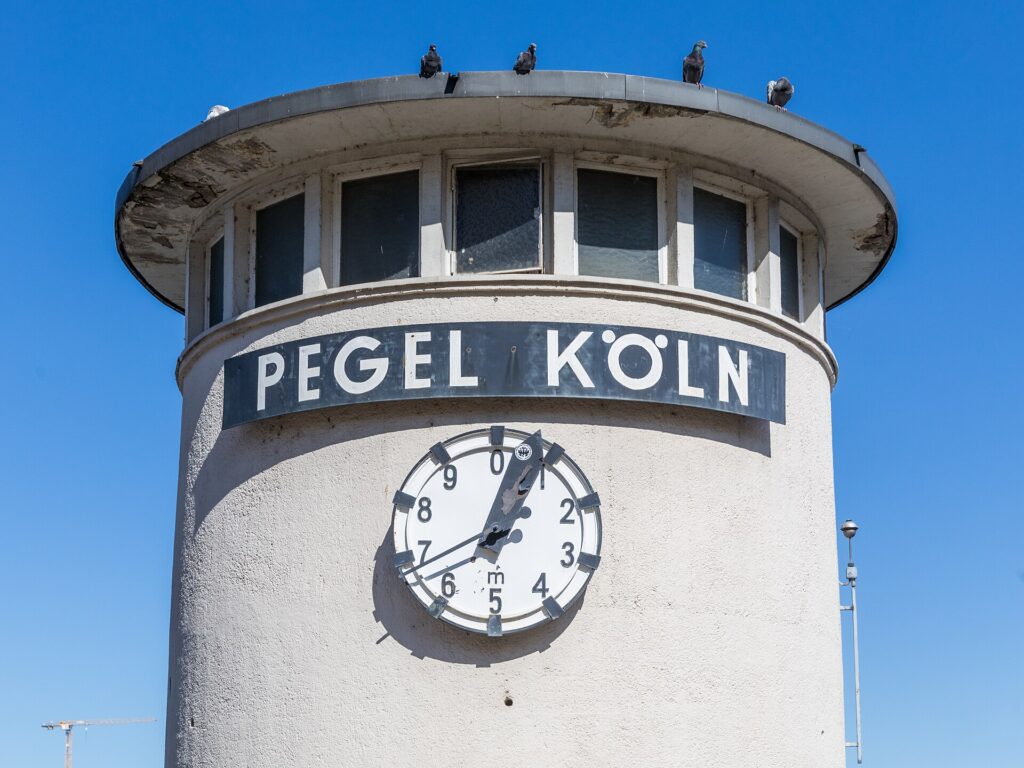
That depth is nevertheless insufficient. A river cruise ship is usually between 110 and 135 metres long, and it needs a clear gap beneath the bottom of its hull. Most ships therefore stop running well before the channel becomes that shallow. Cruise Passenger arrived at the same figure of slightly more than 1.2 metres on 17 August.
Why the Danube Is Recovering and the Rhine Is Not
Conditions on the Danube are different, and somewhat more encouraging. The Hungarian national water directorate recorded a level of 13 centimetres at Budapest late on 18 August. The forecast for that day had been between 8 and 12 centimetres, so the river performed slightly better than expected, although 13 centimetres remains far below the record low of 33 centimetres set in 2018.
The improvement is clearer further upstream. Pfelling, the station that governs the stretch between Regensburg and Passau, recorded 194 centimetres on the morning of 17 August and 211 centimetres on the evening of 18 August. That places the river approximately where it stood at the beginning of the month. Hofkirchen, downstream of Pfelling, is low but stable.
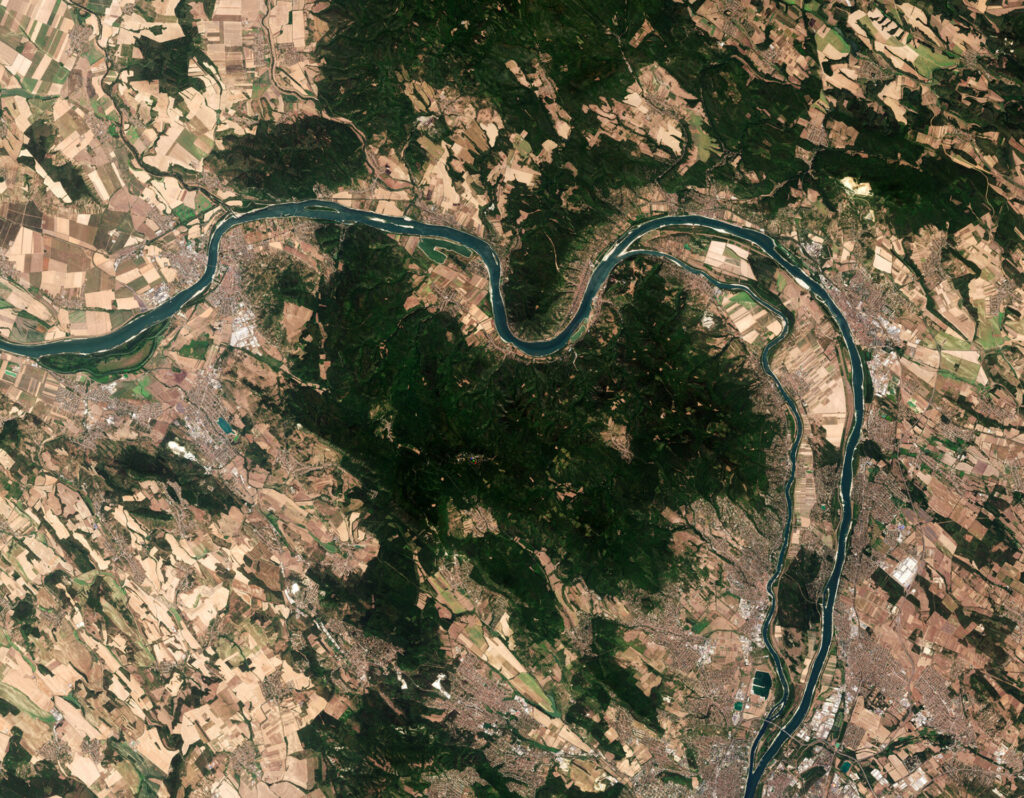
Kaub has behaved in a similar way on a smaller scale, holding between 13 and 14 centimetres against an official forecast of 9 to 12 centimetres. These two sets of readings have not been published alongside one another elsewhere, and the comparison is useful to anyone already booked. The Bavarian Danube is recovering while the Rhine gorge is not, so a cruise leaving Passau and a cruise leaving Rüdesheim face very different odds this week.
What Passengers Are Reporting
The reaction from passengers has been more measured than might be expected. Those who are already travelling are generally complimentary about the way in which crews have managed the disruption, while those waiting to travel in the autumn remain uncertain about what they will get. The 2026 Rhine discussion on the Cruise Critic forum has reached 34 pages since January.
“We will no longer be departing from Basel as our ship cannot make it back down the Rhine.”
DesertDweller1971 — Cruise Critic — River Cruising, August 2026
Other accounts are considerably more positive. A passenger travelling with AmaWaterways from Amsterdam to Basel reported that the line kept the same start and finish cities, moved everybody onto an identical ship further up the river, made sure that every night was still spent on board, and offered 20 per cent off a future cruise.
How the Cruise Lines Are Responding
Riviera Travel is the company most British readers will have booked with, and its position has changed quickly. Eight cruises had been cancelled by the beginning of August and ten by the middle of the month, across the Rhine, Danube, Moselle and Main. The company has still run 27 trips since July, and says that it cancels only when it cannot put together an acceptable alternative route.
Viking is making use of the size of its fleet. It keeps two near-identical ships waiting on either side of the shallow stretch, so that passengers can cross by coach and pick the cruise up again in the same cabin number. Scenic, Emerald, Tauck, Uniworld, APT and Avalon are all doing much the same thing.
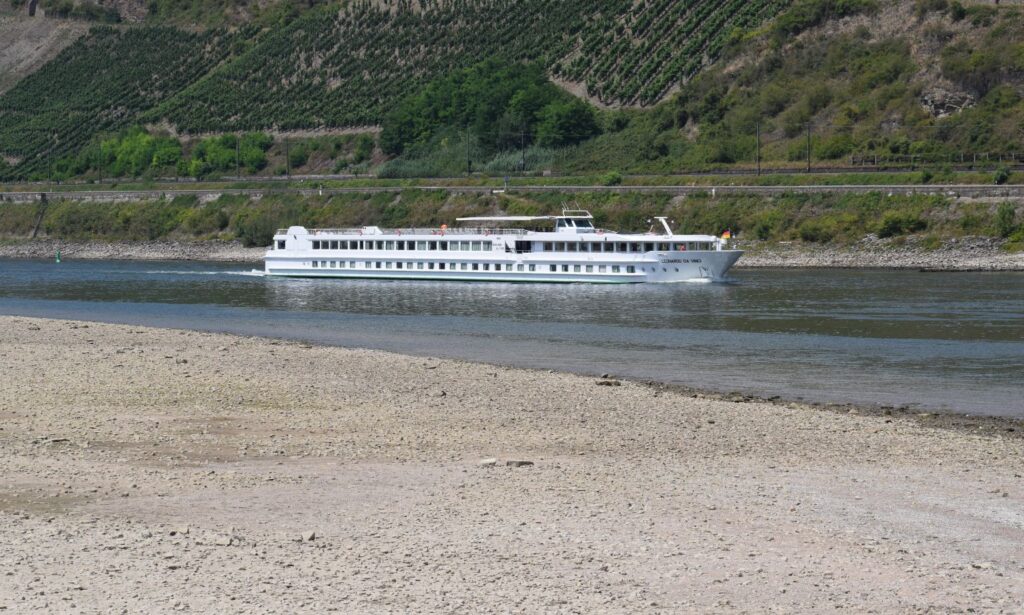
Avalon and Tauck have cancelled some cruises too. The practical consequence is that a general statement from a cruise line tells you very little about your own booking. Two ships on the same river, or the same trip running a week apart, can produce completely different holidays.
What You Can Do
You should establish the condition of your own section of the river rather than rely on national headlines. Both rivers are long enough for one stretch to be closed while another stays open, and the station that matters for your trip depends on your route and on how deep your ship sits in the water.
- Find the station that covers your route. Kaub covers the Middle Rhine gorge, Pfelling covers the stretch between Regensburg and Passau, and Budapest covers the middle Danube.
- Ask a precise question. Rather than asking whether the cruise will operate, ask which ports have been removed and how many hours you will spend travelling by coach.
- Say what you need early. Reduced mobility, dietary requirements and separately booked flights all become harder to sort out once a change of ship has been arranged.
- Do not cancel before the cruise line does. If you cancel first, the company’s normal cancellation charges apply instead of its duty to refund you.
What You Are Owed
Most British river cruises are sold as package holidays, which brings them within the Package Travel and Linked Travel Arrangements Regulations 2018. If an essential element of the package is altered significantly before you travel, you are entitled to reject the alteration, to end the contract without paying a fee, and to receive a full refund.
Your Package Travel Rights
A significant change to an essential element of your package gives you the right to reject it and end the contract.
Compensation on top of that refund is a separate question, and a claim will usually fail where drought is the cause.
Compensation, however, does not follow automatically. Record low water counts in law as an unavoidable and extraordinary circumstance, and ABTA guidance says that a holiday company is not liable to pay compensation when something of that kind has forced the change. The right to a refund therefore survives, but a claim for compensation will normally fail.
Riviera Travel is offering more than the regulations require. A passenger whose cruise has been cancelled may rebook the same trip in 2026 or 2027 at no extra cost, move to another Riviera holiday with any price difference refunded or with £250 per person contributed towards a more expensive one, or accept a full refund together with a credit of 15 per cent.
“No mention of any refunds or credits for the inconvenience. Not what most signed up for.”
Charles — Cruise Passenger — reader comment, 17 Aug 2026
Why This Continues to Happen
The 2018 record at Kaub was set in late October. The 2026 record was set in the first week of August, which means these record lows are now arriving months earlier than they used to. A thin covering of snow in the Alps over the winter, followed by five separate heatwaves across the land that drains into the Rhine, accounts for the difference.
The broader outlook offers little reassurance. The Joint Research Centre of the European Commission has recorded the Loire, the Po, the Rhine and the Danube at record low levels this summer. The German Federal Institute of Hydrology expects Kaub to stay below its reference level of 77 centimetres well into the autumn, and Commerzbank does not expect a significant rise before October.
None of this is a reason to abandon the idea of a river cruise. It is a reason to treat the printed route as a statement of intent rather than a promise, and to put the difficult questions to your cruise line before you pay the balance rather than afterwards. You should read the 2018 regulations and the ABTA guidance before accepting any voucher.
Further coverage of this summer and its effect on European travel is available in our reports on the heatwave disruption to Eurostar and to flights to Spain and France, on the compensation you can claim when infrastructure fails, and on the cruise that was rerouted through the Adriatic partway through the trip.